Michael Hovhannesyan
Senior Partner, Attorney at Law
Introduction
Jurisdiction selection is one of the earliest and most consequential decisions in any iGaming business structure. The choice affects not just your licence — it determines where you can bank, which markets you can credibly serve, what compliance obligations your team will carry, and how investors and commercial partners perceive your business.
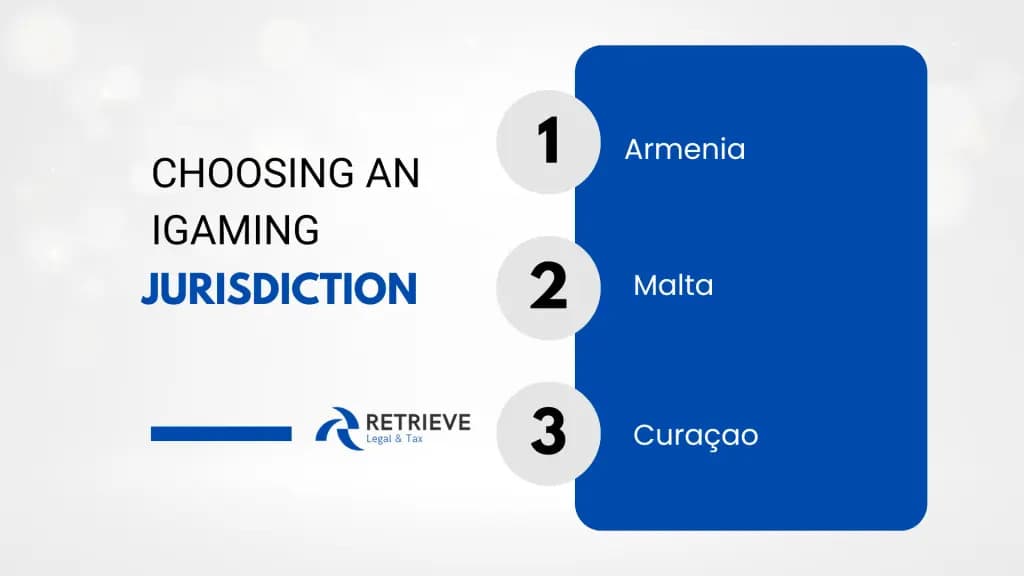
Armenia, Malta, and Curaçao are frequently mentioned together in iGaming discussions, but they serve fundamentally different functions. Treating them as three equivalent options on a shortlist misunderstands how most international gaming groups actually operate. In practice, these jurisdictions are often used in combination, each serving a distinct role within a broader structure.
This article provides a practical legal and commercial comparison of all three, directed at online casino operators, sports betting platforms, B2B software and platform providers, payment service providers, and founders evaluating their structural options.
Armenia vs Malta vs Curaçao: Key Criteria Compared at a Glance
The table below summarizes the principal legal and commercial factors for each jurisdiction.
| Criterion | Armenia | Malta | Curaçao |
| Primary role | Tech/ops entity; holding structures | Licensed B2C/B2B operator; EU market | Accessible entry; start-up and growth operators |
| Regulatory authority | Ministry of Economy (from Jan 2025); State Revenue Committee oversees licensing | Malta Gaming Authority (MGA) | Curaçao Gaming Authority (CGA) |
| Licence type | Domestic market only; no international hub licence | B2C and B2B licences | B2C and B2B licences (LOK, Dec 2024) |
| Typical timeline | Varies; domestic market applications | ~12–18 months | ~3–6 months (new LOK framework) |
| Corporate tax | 18% standard; 1% for qualifying high-tech entities (through 2031) | ~5% effective (full-imputation refund system) | ~22% nominal; licence fees apply |
| Banking access | Reasonable for operational entities | Strong — EU banking ecosystem | Limited; many EU banks decline |
| Market recognition | Domestic only | Highest, recognised across the EU and beyond | Broad but contested; restricted in several markets |
| AML/compliance | Moderate (domestic regime; tightening from 2025) | High — EU AML directives apply in full | Moderate; increasing under LOK |
| Ongoing compliance cost | Lower (operational entity) | Higher (regulatory overhead is material) | Moderate |
| Best suited for | IT/software/ops subsidiary; multi-entity groups | Operators targeting EU markets; institutional clients | Pre-revenue operators; testing a model |
Armenia: A Domestic Market with a Role in International Structures
Armenia iGaming Regulatory Framework
Gambling in Armenia is regulated under the Law of the Republic of Armenia on Games with Prize, Internet Games with Prize, and Gaming Houses, together with implementing regulations. In 2024, the National Assembly adopted the Law on the Regulation of Gaming Activities (the Gaming Law), which entered into force on 1 January 2025. This legislation introduced responsible gambling principles, geo-blocking requirements, mandatory .am domain registration for online operators, and a framework for more systematic state oversight.
Responsibility for developing and implementing state policy in the gaming sector has been transferred from the Ministry of Finance to the Ministry of Economy, which now serves as the principal supervisory authority. Licensing and operational oversight involve both the Ministry of Economy and the State Revenue Committee. Separately, Armenia is in the process of establishing two new dedicated bodies — the Gaming Sector Monitor and the Gaming Operator Institute — to take over regulatory and technical functions as the framework matures.
Armenia iGaming Licensing: What Operators Need to Know
Armenia does not function as an offshore iGaming licensing hub. Its regulatory framework governs gambling activities conducted within or targeting the Armenian domestic market. An Armenian gambling licence confers no right to operate in foreign markets and does not serve as a substitute for licences issued in Malta, Curaçao, or other internationally recognised jurisdictions.
Licence classes include categories for online casino operations, bookmaker (sports betting) activities, lotteries, and totalisator (pari-mutuel) betting. Applicants must be registered as Armenian legal entities, demonstrate financial standing, provide information on beneficial owners, and satisfy technical certification requirements for gaming systems.
Armenia’s recent regulatory tightening is also relevant to any operator considering the Armenian market as a revenue source. From April 2025, online casino and bookmaker licence fees doubled, with further fee increases scheduled through 2028. A 10% turnover tax on all gambling activities took effect from July 2025. The Gaming Law also introduced geo-blocking mechanisms and requires local banks to block payments to unlicensed operators. These measures are actively reducing the space for unlicensed or grey-market activity and increasing the cost of domestic market participation.
Legal Consequences of Operating Without an Armenian iGaming Licence
Conducting gambling activities in Armenia without the required registration and licence constitutes illegal entrepreneurial activity under Armenian law. Administrative sanctions under the Code of Administrative Offences include confiscation of IT and gaming equipment and fines of up to AMD 10,000,000. Criminal liability under the Criminal Code may also apply in more serious cases, with penalties ranging from fines and community service to restriction of liberty or imprisonment, depending on the nature and scale of the offence.
Tax Environment for iGaming Companies in Armenia
Armenia’s standard corporate profit tax rate is 18%. For companies engaged in qualifying high-tech activities and registered in Armenia’s High-Tech Registry, a preferential 1% turnover tax rate applies from 1 January 2025 through 31 December 2031. To access this regime, a company must earn at least 90% of its revenue from eligible high-tech activities and maintain annual turnover below AMD 115 million (approximately USD 300,000). This regime is directly relevant to iGaming technology and software entities, platform developers, and B2B service providers operating from Armenia. Companies that exceed the revenue threshold revert to the standard 18% profit tax system.
Additional incentives available to qualifying high-tech companies include a 200% deduction for qualified R&D salary expenses (capped at 50% of taxable income), a 10% reduced personal income tax rate for certified researchers, and employment tax refunds for new hires and international labour migrants.
How Armenian Entities Are Used in International iGaming Structures
Armenia’s value in international iGaming structures lies not in its gaming licence but in its operational and corporate environment. Armenian entities are commonly used for:
- Software development, platform engineering, and IT operations
- B2B technology and platform services provided to licensed operators elsewhere
- Back-office functions including customer support, compliance operations, and finance
- Regional management and holding company structures
- Operational support for groups licensed in Malta, Curaçao, or other jurisdictions
The combination of competitive operating costs, a growing technology talent base, the 1% high-tech tax regime, and a straightforward company formation process makes Armenia an attractive location for the operational layer of a multi-jurisdiction iGaming group. However, operators considering Armenia should also review the full compliance risk landscape before committing — covered in our guide on key compliance risks for iGaming companies operating in Armenia.
Malta: Regulated Licensing Within the European Union
Malta iGaming Regulatory Framework
Malta is one of the most established iGaming licensing jurisdictions globally. Gambling activities are governed by the Gaming Act (Chapter 583 of the Laws of Malta) and its extensive body of subsidiary regulations. Licensing, supervision, and enforcement are the responsibility of the Malta Gaming Authority (MGA), an independent regulator operating under Maltese law and in conformity with EU standards.
Malta MGA Licence
The MGA issues Business-to-Consumer (B2C) licences for operators offering gaming services directly to players, and Business-to-Business (B2B) licences for suppliers providing gaming software, platforms, and related services to other operators. The licensing process is substantive and includes corporate due diligence on the applicant entity, fitness and probity assessments of beneficial owners and key persons, review of business plans and financial projections, technical platform review, and assessment of compliance frameworks.
The minimum share capital requirement for a B2C licence is €100,000; for a B2B licence, €25,000. The typical timeline from submission of a complete application to licence grant is approximately 12 to 18 months, though this varies depending on application quality, the complexity of the corporate structure, and the MGA’s current processing times.
Malta iGaming Tax
Malta operates a full imputation corporate tax system at a standard rate of 35%, combined with a shareholder refund mechanism. Qualifying gaming operators structured appropriately can achieve an effective tax rate of approximately 5% at the shareholder level through this refund system. The precise outcome depends on the corporate structure, shareholder residency, and the nature of activities conducted in Malta, and should be confirmed with specialist Maltese tax advisors for any specific structure.
Malta MGA Compliance Obligations for Licensed Operators
Licensed operators are subject to comprehensive ongoing obligations. These include anti-money laundering requirements arising from the Prevention of Money Laundering Act and EU AML directives, customer due diligence and transaction monitoring obligations, responsible gaming requirements, technical certification and testing standards, player fund protection obligations, and regular regulatory reporting to the MGA. The compliance infrastructure required to maintain an MGA licence is materially more demanding than that required in most alternative jurisdictions. Operators should build compliance costs into their financial model at the outset — this is not a jurisdiction where compliance is treated as an afterthought.
Commercial Advantages of a Malta MGA Licence
The principal commercial advantages of a Maltese licence are its international credibility, EU regulatory standing, and the banking and payment processing access it facilitates. Major EU and international banks generally accept MGA-licensed entities as clients. Payment service providers, platform vendors, and affiliate networks treat the MGA licence as a credible regulatory baseline. For operators seeking to access European markets, attract institutional investors, or build long-term partnerships with major commercial counterparts, Malta is typically the relevant benchmark.
The corresponding trade-off is cost and complexity. Malta is not the appropriate starting point for a pre-revenue operation or a business that cannot yet support the governance and compliance infrastructure that the MGA requires.
Curaçao: Reformed Framework for International Operators
Curaçao iGaming Regulatory Framework
Curaçao has historically been one of the most widely used jurisdictions for online gaming businesses seeking an accessible route to market. Its regulatory framework underwent fundamental reform between 2023 and 2024. The master licence and sub-licence system that characterised Curaçao’s framework for decades was abolished, and a new direct licensing regime was established under the governance of the Curaçao Gaming Authority (CGA).
The new National Ordinance on Games of Chance (LOK) entered into force on 24 December 2024. Applications submitted on or after that date are processed under the LOK. Legacy sub-licences expired at the end of their respective master licence terms, and operators were required to transition to the new framework during the phased transition period of 2023 to 2024.
Curaçao Gaming Authority Licence
Under the LOK framework, the CGA issues B2C and B2B licences directly to operators and suppliers. The application process is generally considered less intensive than the MGA process, and the typical timeline to licence grant is in the range of three to six months for straightforward applications. The LOK introduces more substantive compliance requirements than the previous sub-licence system, including responsible gambling obligations, AML and KYC requirements, and greater transparency obligations. Operators should not approach a Curaçao application as a purely administrative exercise under the new framework.
Curaçao iGaming Banking Access
Banking access is the most material practical constraint for Curaçao-licensed operators. Many EU-based banks and major international financial institutions decline to service Curaçao-licensed entities. Payment processing options exist but are generally more limited and more costly than those available to MGA-licensed operators. Operators targeting EU member states should assess carefully whether a Curaçao licence provides the access they need: several European regulators treat Curaçao-licensed operators as unlicensed in the local context, and some markets have taken active enforcement action against Curaçao operators targeting local players.
Who Should Consider a Curaçao iGaming Licence and Why
Curaçao continues to attract operators who are at an early stage, testing a business model before committing to the cost of a more regulated licence, or targeting markets where EU-level regulation is not required. Its comparatively efficient licensing process, lower entry costs relative to Malta, and global name recognition within the iGaming industry are genuine advantages in the right context.
It is not the appropriate jurisdiction for operators seeking EU market credibility, institutional banking relationships, access to major payment platforms, or a long-term regulatory base that facilitates partnerships with EU-regulated counterparts.
Multi-Jurisdiction Structuring: How These Three Work Together
In practice, the most commercially effective iGaming structures rarely rely on a single jurisdiction. A typical multi-entity structure might involve:
- A Malta or Curaçao entity holding the gaming licence and entering into player-facing agreements
- An Armenian entity providing technology services, platform development, or B2B support functions under intercompany service or licence agreements
- A holding entity in a third jurisdiction managing equity, IP ownership, and group financing
This structure allows a group to maintain a recognised gaming licence in an internationally credible jurisdiction while benefiting from Armenia’s cost-efficient operational environment, strong technology talent pool, and favourable tax treatment for qualifying high-tech entities. The intercompany agreements underpinning such structures — service agreements, IP licences, management fee arrangements — require careful drafting to reflect the commercial substance of each entity’s activities and to support the intended tax treatment.
The appropriate structure depends on the operator’s target markets, investor base, compliance capacity, and long-term plans. There is no standard template; the right architecture is the one that reflects the actual business.
Conclusion
Armenia, Malta, and Curaçao serve different purposes. Malta is the standard for EU market credibility and long-term regulatory standing, at the cost of significant compliance investment. Curaçao under the new LOK framework offers a more accessible licensing pathway with genuine trade-offs in banking access and market recognition. Armenia is not an international licensing jurisdiction, but it is an increasingly well-regulated and commercially attractive operational base for iGaming groups that need a cost-efficient, legally structured presence in a capable business environment.
For most serious operators, the question is not which single jurisdiction to choose — it is how to combine jurisdictions to match the actual structure of the business.
How Retrieve Legal & Tax Can Help
Retrieve Legal & Tax is a Yerevan-based boutique legal and tax advisory firm with experience in iGaming corporate structuring, cross-border transactions, licensing coordination, and intercompany agreement drafting. Our practice covers Armenian legal entity formation and structuring, intercompany and B2B service agreements, tax structuring for multi-jurisdiction iGaming groups, and coordination with specialist counsel in Malta, Curaçao, and other licensing jurisdictions.
If you are evaluating jurisdiction options for a new iGaming structure, restructuring an existing group, or establishing an Armenian operational entity as part of a broader operation, contact us to arrange a consultation.
Legal Disclaimer
This article is published for informational purposes only and does not constitute legal advice. The information reflects our understanding of the relevant legal frameworks as of the date of publication and is subject to change. Readers should not act or refrain from acting on the basis of this article without obtaining specific legal advice tailored to their circumstances. Retrieve Legal & Tax accepts no liability for decisions taken in reliance on its contents.